
The Rest of the Life Does Not Receive the Wire
What sudden wealth reveals about the parts of a life that do not move together.
Left: Tiffany Ap, "Tech's New Rich Are Suffering From 'Sudden Wealth Syndrome'", Bloomberg, 11 September 2026. Right: Ryna Mi, The Wealth of One Life.
A company is sold, the money arrives, and the question that organised a working life — how to have enough — is answered in a single afternoon.
What comes next is the subject of Tiffany Ap's Bloomberg piece on "sudden wealth syndrome". The founders she spoke to were not describing failure. Their money was exactly where it should be. They described years adrift, friendships that had to be renegotiated, achievements that did not deliver the peace they had been saving for. One of them, Michia Rohrssen, found the dread that followed his $110 million sale darker than the poverty he had grown up with. He puts it in five words:
“But I did the thing?”
Some of what they describe is real suffering, and some of it belongs with clinicians rather than with essays. But the line I kept returning to was not about suffering at all. It was Sam Parr's advice, as the article reports it: after an exit, do nothing irreversible for at least a year.
That is advice about order, not about money. It assumes something the word syndrome tends to hide — that the money and the rest of a life do not move at the same speed.
The money can change in a day. The rest of the life does not receive the wire.
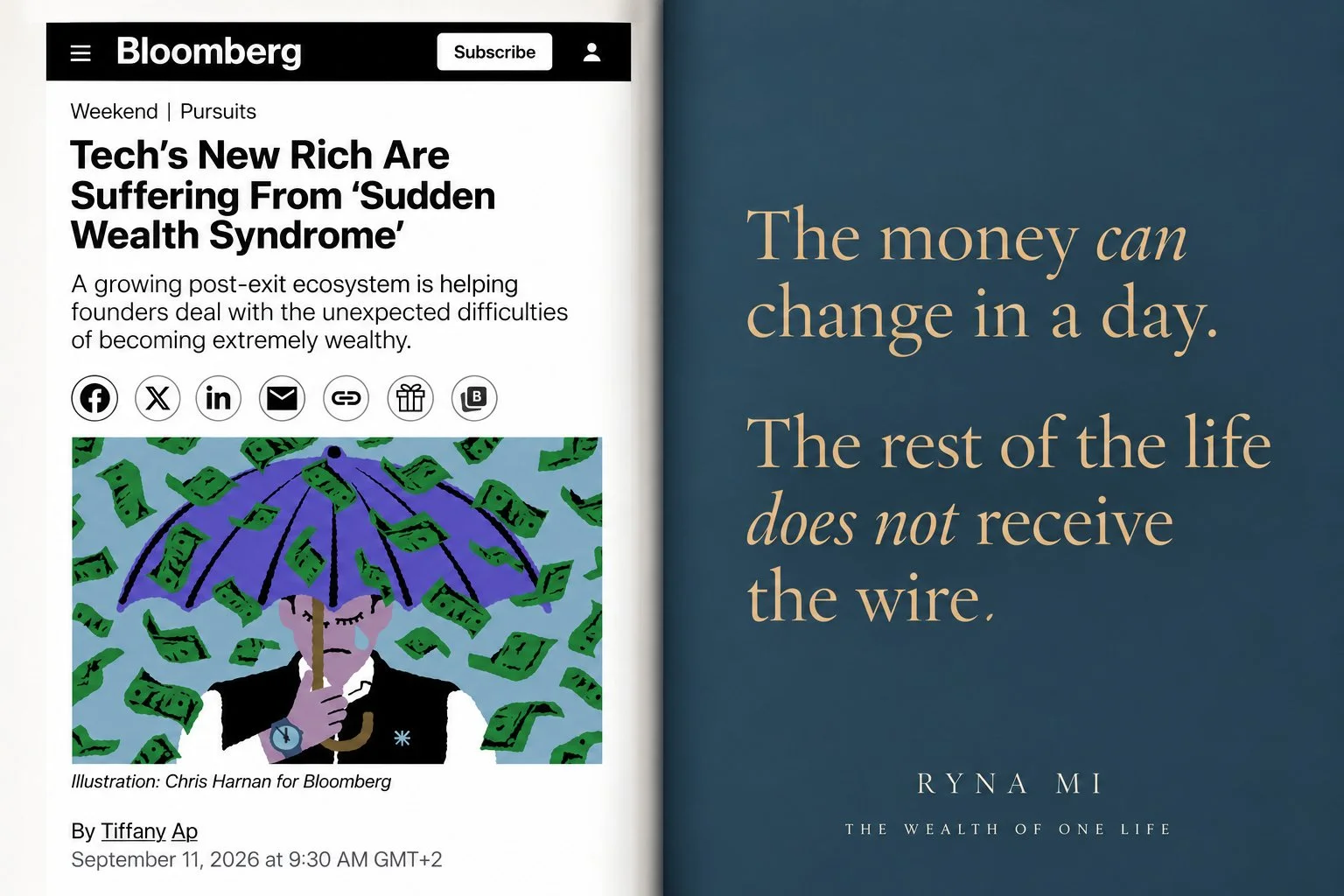
Credit to Chris Harnan for Bl0omberg.
What money can do that nothing else can
Money's great property is that it travels. It crosses a border in seconds, becomes a house or a foundation or a gift, can be divided between children or lent to a friend, and can change hands while everyone involved is asleep. Very little else you value behaves like that. A relationship does not transfer at closing. A body does not receive ten years of sleep because an account received another zero. Judgment does not come with the proceeds, and an afternoon that has suddenly become free does not arrive with a reason to spend it.
None of this is an argument against money. It is precisely because money is so useful, and so easily converted, that its properties are so readily mistaken for the properties of wealth itself.
In The Wealth of One Life, the book I am finishing, I describe a life's wealth as a house seen through nine windows, and money as one of them. Watching that window is not the mistake; it deserves watching. The mistake is to take the view through it for the house. A sale makes the difference hard to miss. The view through one window changes overnight. The house does not.
What the company was carrying
A company does far more work in a founder's life than its accounts can show. It supplies the problems and the deadlines, decides who calls in the morning and where attention goes, and gives Monday a different shape from Sunday. It may quietly have been organising friendships, a marriage, sleep, health, standing — and the answer to a question most people never have to say out loud: what am I for today?
It is a very large question to put to a house that has just lost half its furniture.
None of that is in the sale price. At closing, the financial value of the enterprise converts almost completely. The rest of what it carried cannot simply be converted. Some of it stays where it was, some of it leaves with the company, and some of it turns out never to have been held anywhere else.
This may be why what is my purpose now? so often comes too early. It is a very large question to put to a house that has just lost half its furniture. A smaller one might come first: what had the old life been doing for you, without being asked? Where did your usefulness come from, and which of your relationships belonged to you rather than to the role?
For twenty years I worked on the financial side of other people's fortunes. Many of the people I sat beside had excellent numbers and lives that were doing something the numbers could not register. The measures were not lying. They measured what they had been built to measure, which was how much someone held. They could not say what kind of whole those holdings formed, what was feeding what, or what was being spent while the total rose. That discrepancy is a large part of why I began building a different language for wealth.
After an exit, the same discrepancy decides what kind of help a person reaches for. If the trouble is read as "I have too much money and it has made me unhappy", the obvious remedies follow: therapy, philanthropy, another company, a retreat, a bigger house or a smaller one. Any of them may help. But they answer different problems, and without first locating where the trouble lives, activity becomes another way of not seeing it. Sometimes what has changed is identity, sometimes a relationship, sometimes the structure that held the days together. Sometimes the body is simply presenting the bill for the years of building. And sometimes nothing is wrong at all, and a person is living through the lag between an event that happened instantly and a life that can only reorganise at human speed.
The term sudden wealth syndrome emerged in clinical practice in the late 1990s and early 2000s, and it has never become a formal diagnosis. The name makes these stories sound as though wealth had produced an illness. Often the plainer reading is the truer one. One part of the life moved. The rest has not yet found its new arrangement.
Not everything converts
The valuable things in a life do interact. Money can buy time back, and there is good evidence that spending it that way raises well-being (Whillans et al., 2017). Time can build skill. A relationship can open a financial door. But interaction is not equivalence. A surplus of money cannot refill a depleted marriage, and a reputation in your field is not the same thing as someone to call at three in the morning. Money can help almost everything else. It cannot stand in for it.
Freedom turns out to be less the absence of constraint than the arrival of authorship.
This matters most when someone suddenly holds enough money to make nearly every purchasable problem disappear. It becomes tempting to treat the remaining problems as purchasable too. Some are. Others become harder precisely because the money has removed the constraint that used to make the choice. When you have to work on Monday, Monday is decided. When you no longer have to, it is yours — and freedom turns out to be less the absence of constraint than the arrival of authorship.
That is why the advice about irreversible decisions goes deeper than it sounds. A life does not only contain different things; it contains them in an order, and the order changes what they become. Rest after the collapse is not rest before it with the dates changed. A decision held back while more becomes visible is not always indecision; sometimes it keeps open an option that cannot be made again. Economists worked this out half a century ago: when a choice cannot be undone and more will be known tomorrow, waiting has a value of its own (Arrow & Fisher, 1974; Henry, 1974). They were thinking about forests and rivers. The logic carries over to a life. In the theory behind my work it takes a stricter form — identical starting points can diverge into very different lives through order alone (Mi, 2026). The moves do not commute.
Having freedom and having enough sight to spend it well are not the same thing.
There is no universally correct sequence after an exit. Selling the house, moving countries, starting again, leaving a marriage, giving away half the fortune, buying the ranch: any of these may turn out to be right. The question is whether it needs to be right now. Having freedom and having enough sight to spend it well are not the same thing, and the first year is often the distance between them.
The strongest objection
The article ends on a harder view than mine: that there may be no lasting fix at all, because staying dissatisfied is how the species has survived. Rohrssen himself leans that way, at least for now.
He may be right. Nothing about order promises contentment, and I would not offer it as a cure. What it offers is narrower: fewer doors closed before you know which rooms you will need. If restlessness is simply the human condition, it is still better met with your options intact.
The financially rich may simply be early
Towards the end of the piece the question widens. Drawing on the philosopher Nick Bostrom's idea of a "deep utopia" (Bostrom, 2024), the article suggests the post-economic few may be a pilot study for everyone else. That is speculation rather than forecast, but it deserves to be taken seriously.
For most people, economic necessity answers a remarkable number of questions before they are ever asked: where to be at nine, what to become good at, whom to spend the day with, when you are allowed to stop. You may dislike the answers, but they are there. Take necessity away and every one of those questions comes back at once, unanswered. If AI reduces how much human labour a society needs, more people will meet some version of what founders are meeting now after an exit — not how to become rich, but something stranger: what is wealth for, once earning no longer tells you how to spend a life?
The financially rich may not be a separate species with an exotic affliction. They may simply be among the first to be asked a question that necessity has answered for everyone else.
The morning after
The money is there, the accounts work, the advisers have begun, and the old calendar has gone. Some parts of the life are suddenly abundant, some are unchanged, and some turn out to have depended entirely on the thing that has just ended. Often there is no syndrome in that, only a very fast event inside a very slow organism.
The temptation is to fill the space at once, with a new company, a cause, a house, a purpose. The wiser first act may be simply to see what arrived with the money, and what did not.
The transfer settles in a day. The life still has to move.
What the Wealth?! Koan
The wire arrived.
What has not?
A question for you
If you have lived through a sale, an inheritance or the end of a role that organised your days: what changed first — and what took longest to catch up?
References & Resonances
This essay is in conversation with others. Some reported what founders lived through. Some showed, long before any founder needed it, why a choice that cannot be undone deserves patience.
The occasion
Tiffany Ap (2026) — "Tech's New Rich Are Suffering From 'Sudden Wealth Syndrome'", Bloomberg, 11 September 2026. The reporting and the voices this essay responds to. bloomberg.com
Stephen Goldbart & Joan Di Furia (2000) — the Money, Meaning and Choices Institute therapists who named the pattern, as reported by Valerie Andrews, "Signs of Sudden Wealth Syndrome", WebMD, 17 April 2000. webmd.com
Annie Wright — "Is Sudden Wealth Syndrome Real?" — on the origin of the term with Stephen Goldbart and Joan DiFuria, and its status as a descriptive label rather than a diagnosis. anniewright.com/is-sudden-wealth-syndrome-real
On irreversibility and the value of waiting
Kenneth J. Arrow & Anthony C. Fisher (1974) — "Environmental Preservation, Uncertainty, and Irreversibility", Quarterly Journal of Economics 88(2), 312–319 — why uncertainty argues for caution before acts that cannot be reversed. IDEAS/RePEc
Claude Henry (1974) — "Investment Decisions Under Uncertainty: The 'Irreversibility Effect'", American Economic Review 64(6) — the same insight, reached independently.
Avinash Dixit & Robert Pindyck (1994) — Investment under Uncertainty, Princeton University Press — the option to wait, generalised.
On what money can and cannot convert
Ashley Whillans et al. (2017) — "Buying Time Promotes Happiness", Proceedings of the National Academy of Sciences 114(32). doi.org/10.1073/pnas.1706541114
Ryna Mi (2026) — "Existential Portfolio Theory: A Multi-Capital Theory of Wealth for a Single, Finite Life", v1.0 — the sequencing thesis: identical endowments can diverge by order alone. doi.org/10.5281/zenodo.22057070
On the wider question
Nick Bostrom (2024) — Deep Utopia: Life and Meaning in a Solved World, Ideapress — what a person does when nothing is required of them.
Their work supplies the scaffolding.
The order is each life's to find.