
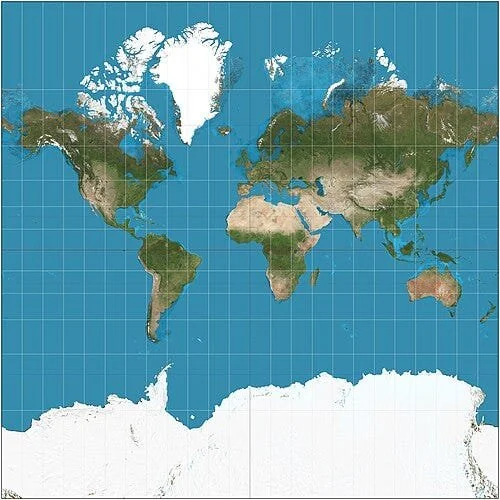
The Mercator projection. Image: Strebe, via Wikimedia Commons, CC BY-SA 3.0.
Five generations. An estimated 40% of a stock exchange. Not one appearance on any rich list, ever. A letter about the wealth our instruments cannot represent, the family that placed its fortune beyond their reach a century ago — and one claim you are invited to prove wrong.
The Miseducation of Wealth, Letter I. First published in What The Wealth?! on LinkedIn, 5 August 2026.
A dinner in Stockholm
There is a dinner held every year outside Stockholm.
The guest list is one family — 5 living generations of it. What is discussed there has never leaked in any detail that matters. Journalists have managed to learn the menu. Everything else — who is being prepared for what, which of the 6th generation is ready — stays in the room.
The family is called Wallenberg. You may know the name faintly, or not at all, which is by design. Their motto is esse non videri — to be, not to seem.
Here is what they are, behind the not-seeming. Guiding hands of ABB, AstraZeneca, Ericsson, Atlas Copco, SEB, Saab. An estimated 40% of the Stockholm stock exchange, by value, moves under their stewardship. 5 generations, 110 years.
Now open the Forbes billionaire list and look for them.
No Wallenberg has ever been there.
The What The Wealth ?! koan
The most powerful family in Sweden owns almost none of what it commands. Both halves of that sentence are documented fact.
This letter is about how that is possible. The wealth in question is not hidden — the family sees it, their advisers see it, historians see it. What follows is about something stranger: wealth our civilisation’s formal instruments have no category to represent — and a family that placed its fortune there deliberately, a century ago.
What the list would say
Suppose the 16 Wallenberg foundations were a person. Their combined assets at year-end 2025: roughly $39 billion. On the 2026 Forbes list, that lands around #50. Count what the family steers rather than what the foundations hold, and you are in the top 5, alongside Musk and Arnault.
#50 or top 5 — either way, a fixture of every list ever printed. Actual placement: nowhere.
The reason is not secrecy; the numbers are public and audited. The reason is category. Forbes answers one precise question: what does this individual own, and what could they sell it for? The Wallenberg answer is: nothing, and nothing. The instrument is not broken. It is answering its question perfectly. The question is simply too small.
The family that disinherited itself
It begins with a failure. André Oscar Wallenberg, founder of Stockholms Enskilda Bank, died in 1886 leaving roughly 20 children from 2 marriages. The heirs quarrelled, the estate fragmented, the bank nearly did not survive. Every language has a proverb for this script — shirtsleeves to shirtsleeves in three generations.
His eldest son Knut inherited a position, not a fortune: the bank’s presidency, amid the wreckage. Over 25 years he rebuilt the wealth himself, until the concentration his father’s death had scattered existed again — in one pair of hands.
Then Knut made a decision that, in the historian’s account, his own family received as a betrayal.
The foundation’s own account of that autumn is spare: 1917, Knut in his 65th year, exhausted, bedridden, turning over what would happen when he and Alice were gone. They were childless — not, Wetterberg’s account suggests, by choice. His half-brother Marcus, who ran the bank after him, expected his own sons to inherit. Instead, Knut moved essentially everything into a foundation — irrevocable, perpetual, beyond everyone’s reach including his family’s, its charter fixed forever on the landsgagneliga: that which benefits the country.
Then the renunciation became a tradition. Jacob left the bulk of his estate to foundations. So did Marcus Jr. So did Peter Sr. Generation after generation, the family’s leading members built personal fortunes — and handed the concentration back to the structure instead of to their children. 16 foundations now. Knut’s seed of SEK 20 million has since given away 42 billion in research grants and grown to 303 billion anyway.
Tax played a part in this history — Sweden’s mid-century tax regime made foundations the only way to keep an industrial fortune whole, and a later letter weighs that bargain honestly. But it cannot explain the founding act: Knut’s foundation predates the confiscatory taxes by decades.
What passes between generations instead of money: board seats, judgment, obligation, preparation. The 5th generation runs the system as 3 cousins — investments, industrial holdings, foundations. The 6th is being formed now.
The historian Gunnar Wetterberg — commissioned to write the family’s history on terms that barred any editing of his text, though not its burial; the funders bought the manuscript and kept the right to shelve it — records that Marcus Sr. saw Knut’s move as a betrayal, and judges it the family’s greatest stroke of luck: without it, the fortune would have scattered, as it already had once before. What the family thinks of that verdict, they have never said publicly. What they have done is repeat the act — 5 times, across a century. Some agreements are legible only in behaviour.
The Objection
Every letter in this series will contain this section: the strongest case against its own argument.
A good sceptic stops me here: there is no mystery. What the Wallenbergs kept is simply control — votes without value. Corporate finance has understood the separation of voting rights from cash-flow rights for a century. Forbes doesn’t count votes. Puzzle dissolved.
And the sceptic can go further. The family is hardly unpaid: chairmanships carry compensation, the name opens every boardroom in Europe, and the structure delivered what money alone never buys — permanence, standing, a kind of modern nobility, with wealth taxes sidestepped and criticism pre-answered by research grants. On this reading there was no renunciation at all. There was the shrewdest purchase in the history of wealth.
Sit with that version for a moment, because it may be partly true. Then notice what it concedes.
If the family bought legitimacy, permanence and standing — paying billions, generation after generation — then those things are real, they are acquirable at a knowable price, and they appear on no ledger anywhere. The more cynical the reading, the stronger the conclusion: something invisible to every instrument was worth more than everything the instruments could see. The sceptic has not dissolved the puzzle. The sceptic has priced it.
And there is a control on the experiment. Structures exist — the Dutch have perfected them — that let a family keep the votes and the fortune: control locked in a foundation, value flowing to heirs. The Heineken family uses exactly this; Charlene de Carvalho-Heineken sits on the Forbes list, wealth intact, control entrenched. That option was available to the Wallenbergs at every generation. They declined it, generation after generation, choosing the version that surrenders the money when the version that keeps it was on the shelf.
Whatever the family is holding — stewardship or nobility, duty or disguise — they have consistently valued it above the fortune itself, and no instrument we possess can see it. That is the finding. What the thing actually is, this series will take letters to say.
Why this is more than a curiosity
We govern what we measure — and measurement never merely observes wealth. It defines it.
Wealth taxes are assessed on ownership. Inequality statistics are compiled from ownership. The entire public argument about concentration runs on the same instruments that cannot register the Wallenbergs — a wealth tax of the kind regularly proposed across Europe would assess Sweden’s most consequential family at approximately zero. Whatever you think of that outcome, it should at least be visible to the people designing the tax. It is not.
And the failure is not one family. A foundation holds 92% of Bosch. Trusts hold 2/3 of Tata Sons — Ratan Tata ran over 100 companies and was never a Forbes billionaire. Rolex belongs entirely to a foundation. In Denmark, industrial foundations control 25% of the 100 largest companies and some 60% of the stock market: an entire national economy sitting substantially outside the category our statistics call wealth.
Economics learned that GDP was not enough. Psychology learned that IQ was not enough. Wealth has yet to learn the same lesson.
The wisest advisers to such families have understood half of this for decades — a tradition of thinkers, Jay Hughes and Dennis Jaffe foremost, has long taught that a family’s wealth is human and intellectual before it is financial. What that tradition has never had is the measurement case: proof that our civilisation’s instruments cannot register the very thing it describes.
The claim
Every letter in this series will stake one claim that could be proven wrong. This is the first.
There is a natural experiment on exactly this question — and it involves a structure far murkier than the Wallenbergs’: IKEA’s foundation web has been credibly criticised as engineered for tax and family benefit as much as for purpose. That murkiness is the point. When Ingvar Kamprad placed IKEA irrevocably into foundations, the world’s 2 great rich lists examined the same charters and split. Forbes, once Kamprad’s lawyers proved the family was barred from the assets, cut him from $23 billion toward $3 billion. Bloomberg, reasoning that he still controlled the structure, kept him near the top of the world — $58.7 billion at the same moment Forbes said $3.5 billion.
A $55 billion disagreement, about 1 man, from identical documents. The most sophisticated instruments on earth could not even agree on the prior question — whether this was renunciation or disguise.
So here is the claim: no instrument in use today — no rich list, no national statistic, no wealth-tax base — can measure purpose-held capital as what it is. Confronted with it, measurement does not count; it fractures. The capital either vanishes from the ledger or is fictively re-attached to a person who cannot spend it.
Show me the exception — an instrument, anywhere, that carries purpose-held capital as its own category — and I will publish the correction with your name on it.
The open ledger
Established: the measurement failure exists, it is vast, and at least one family built its permanence inside it, on purpose, for 5 generations.
Open, and coming next:
Why does the structure exist almost nowhere? No French Wallenbergs, no American, no Japanese, no Arab ones. Not culture — 4 specific legal conditions. The next letter maps them, through 1,000 years of Islamic law and the strangest legislative story I know.
What does the family actually possess? Something is held — held above the price of every fortune they surrendered. Our ledger has no column for it. Naming it is what this series will attempt.
And should any of this be admired? There is a dark reading — entrenchment wearing stewardship’s clothes. It deserves its strongest voice, and will get a full letter.
Epilogue
The dinner outside Stockholm will be held again this year.
5 generations at the table, a 6th being measured for chairs. Nothing to inherit, in the way our statistics use the word. Everything to receive.
Somewhere between those two sentences is a definition of wealth our instruments have never captured.
A question for you
Many of you advise such families. Some of you belong to one.
If your family — or a family you serve — has chosen some form of invisibility, I would like to hear how you would answer the koan: what is it, exactly, that is being held? Reply or comment; the best answers will shape the letters ahead, with credit
I also write on Substack, in The Wealth of One Life, where my reflections on wealth and the systems shaping our lives come together. If you'd like to follow these questions further, you're very welcome to join me there..
Sources & further reading
Primary sources
Wallenberg Investments AB — combined assets of the 16 Wallenberg Foundations, approximately SEK 370 billion at year-end 2025; ownership structure of Investor AB and FAM AB.
Knut and Alice Wallenberg Foundation (kaw.wallenberg.org) — the Foundation’s own account of its 1917 founding, the SEK 20 million initial endowment, and cumulative grants of nearly SEK 42 billion.
Investor AB — ownership and voting-structure disclosures, including the KAW Foundation’s 20.07% of capital and 42.96% of votes.
Books
Gunnar Wetterberg — Wallenberg – ett familjeimperium (Albert Bonniers, 2013). The commissioned family history, written on condition of full authorial independence; source for Marcus Sr.’s reception of the 1917 decision and its assessment as the family’s greatest stroke of luck.
James E. Hughes Jr. — Family Wealth: Keeping It in the Family, the founding text of the tradition holding that a family’s wealth is human and intellectual before it is financial.
Dennis T. Jaffe — Borrowed from Your Grandchildren, the largest empirical study of 100-year family enterprises.
Steen Thomsen — The Danish Industrial Foundations (2017), the definitive research programme on foundation-owned firms, including the finding that they control some 60% of Danish market capitalisation.
Reporting & data
NZZ — “Sweden’s Wallenberg legacy: power in the shadows” (2025), source of the estimated-40% figure.
Financial Times — succession coverage, 2024–2025, including “The Wallenbergs start succession to sixth generation.”
Forbes World’s Billionaires 2026 — ranking thresholds.
Forbes and the Bloomberg Billionaires Index, 2011–2016 — the divergent valuations of Ingvar Kamprad following the disclosure of IKEA’s foundation ownership.
The lineage this series follows
Stephen Jay Gould — The Mismeasure of Man (1981).
Joseph Stiglitz, Amartya Sen & Jean-Paul Fitoussi — Mismeasuring Our Lives: Why GDP Doesn’t Add Up (2009).
This series joins a long tradition of asking whether our instruments have mistaken the phenomenon they claim to measure.
The Miseducation of Wealth
Letter I · The Wallenberg Puzzle
Letter II · The Kitchen at Aqabat al-Takiyya
Letter III · Chocolate Town Square
Ryna Mi writes on how wealth is measured, held and stewarded, and is the founder of The Wealth School in Montreux. Her papers are listed on SSRN and Google Scholar; ORCID 0009-0003-5888-2958.