
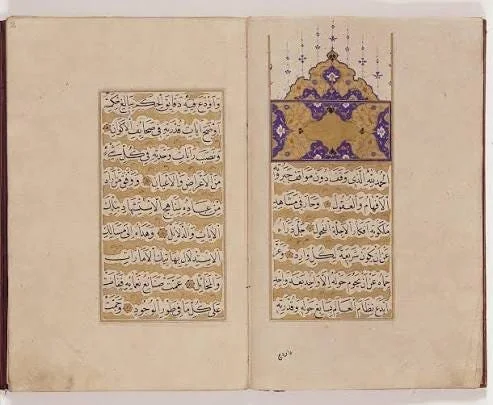
The endowment charter (waqfiyya) of Haseki Hürrem Sultan, 964 AH / 1557. Istanbul.
Since 1552, one kitchen in Jerusalem has passed through empires, war, lost endowments and changing law. What remained raises a prior question about wealth: before we measure what people own, who decided what ownership is allowed to mean?
The Miseducation of Wealth, Letter II. First published in What The Wealth?! on LinkedIn, 11 September 2026.
There is a lane in the Old City of Jerusalem, one block south of the Via Dolorosa, named for a kitchen. Aqabat al-Takiyya: the rise of the soup kitchen. Behind a doorway in a 14th-century Mamluk palace, a kitchen has cooked for the poor since the 1550s. In March 2026, people were still queuing outside this courtyard for hot meals — families sending a child or a woman with a pot to carry the portions home, up to 500 meals a day in Ramadan, and more people coming than before, the Waqf’s director said.
Hürrem Sultan, wife of Süleyman, endowed it by a deed of May 1552 — re-issued in an illuminated copy dated 964 AH, 1557, that survives in Istanbul — naming 195 places: whole villages along the road from Jaffa to Jerusalem, shops, bathhouses, soap works, flour mills. Their revenues were to feed anyone who entered: a ladle of soup and two loaves at every meal.
I want to be exact about what happened next, because the version that circulates — the oldest continuously operating soup kitchen in the world — is not true, and the true version is better.
Oded Peri, reading the Ottoman records, found that by the 18th century the endowed income was being captured by the notables who administered it and provision had fallen from two meals a day to one: kept alive, no longer viable. Amy Singer writes that it continued to function, though not always for those it was built for. Then, in 1948, most of the endowed villages emptied in war and their land passed to a new state. The revenues that had fed the kitchen for four centuries all but stopped. It runs now on the Jerusalem Islamic Waqf, a department of Jordan’s Ministry of Awqaf, and on donations.
So the endowment did not survive. Neither did the sovereign: four orders have governed this building — Ottoman, British, Jordanian, Israeli — each inheriting the kitchen as a fact it had not created. What survived — or was renewed under the same name — was the purpose. I will come back to that distinction.
It is the whole of this letter. We speak of continuity as if it were one thing. At this door it is four: the endowment, the sovereign, the institution and the purpose. The endowment was lost. The sovereign changed with every flag. The institution contracted, was captured, was rebuilt. The purpose passed through all of it — and so, quietly, did the deed’s title to the building, which no sovereign has claimed. The instrument did not preserve the property that fed the kitchen; it detached a purpose from every owner who could die or be conquered.
The question this produces reaches beyond Jerusalem. What idea of property had to become normal before this kitchen came to look strange?
Two corrections before we go on. In the first letter I promised four legal conditions. The research did not produce four. It produced three ideas about what ownership is for. And I wrote that there were no French Wallenbergs, no American. That was too absolute. The Fondation Pierre Fabre holds 86% of the Pierre Fabre group; the Milton Hershey School Trust has controlled the Hershey Company since 1918 and still casts roughly 79% of the combined vote. What makes them exceptional is this letter’s subject.
To see how a purpose can outlive its property, one has to ask a question most of us have never been asked. Who is property for?
The deed at Aqabat al-Takiyya gives the first answer. In the dominant view of Islamic law — Abu Yusuf and al-Shaybani among the Hanafis, the Shafi‘i and Hanbali schools — the founder of a waqf extinguishes her own ownership. The corpus passes out of the founder’s hands; to God, in the Shafi‘i formulation. What remains human is the usufruct, dedicated to a purpose, and a custodian, the mutawalli, who administers what he does not own. Abu Hanifa himself dissented, and the Malikis hold the founder’s title in a different suspension. But the majority answer is clear. Property is for the purpose to which its owner surrenders it. A fortune that never returns to anyone is, here, ordinary.
The common law gives the opposite answer, and gave it early. In 1279 Edward I’s Statute of Mortmain forbade conveying land into the “dead hand” of a body that never dies and so never paid what death triggered. Four centuries later the Duke of Norfolk’s Case began the Rule against Perpetuities, hardened by the 19th century into a formula: an interest that might vest beyond lives in being plus 21 years is void. Beneath both, as I read them, is a conviction that property belongs to the living and should remain alienable. The common law has immortal bodies — the corporation is one — but they have owners. An immortal purpose with no owner has, in the core of the tradition, one door: the charitable trust, where the court may redirect the purpose and the state watches the trustees. Here the exception is any holding by someone who cannot die.
The third answer belongs to the foundation. Swedish law defines a stiftelse by an absence: no owner, no members. A founder separates property for a purpose, and from that moment it belongs to a legal person that belongs to no one. Germany’s Stiftung and Denmark’s enterprise foundations rest on the same idea. In 1889 Ernst Abbe founded the Carl Zeiss Stiftung and two years later gave it the optical works; it has been sole owner of Zeiss since 1891 and of Schott since 1919, through empire, republic, a dictatorship that rewrote the statute against the founder’s will, expropriation in Jena in 1948 and reunification after 1990. Knut Wallenberg’s foundation of 1917 stands in the same family. So do Denmark’s largest companies, though the numbers deserve care: the Carlsberg Foundation holds around 29% of the capital and 76% of the votes, and the gap between those figures is the work of a separate instrument, the dual-class share. Here a company with no shareholder is ordinary.
Three answers to one question. Zeiss is here to show that the first is not an Islamic curiosity: a secular law, from different premises, reached the same destination — capital held by a purpose, administered by a steward, beyond the reach of heirs.
The strangest legislative story I know is what happened to the first answer in the 20th century.
Tunisia became independent in March 1956. Sixteen months later, private waqf was abolished; the public endowments had already passed to the state. Over three decades, across several states, a form of holding that had built universities, hospitals and kitchens for close to a millennium was restricted, transformed or abolished. Turkey’s civil code of 1926 translated waqf into “foundation” and dissolved much of what the word had meant. Syria abolished family and mixed waqf in 1949 and ordered the existing estates liquidated. Egypt abolished the family waqf in 1952. The colonial prelude was French Algeria, where land that could not be sold stood in the way of settlers. Different states, different projects, different years — but one direction. One conception of ownership became legally illegible and another replaced it.
This bears on my claim that there were no Arab Wallenbergs. Part of that apparent absence is legislative rather than cultural; how large a part, I do not know. Whether those states were right, I do not say here. That question has a letter of its own.
The mirror is worth one paragraph. In 1969 the US Congress, after Wright Patman’s campaign against foundations used to keep family control of companies, forbade private foundations from holding more than a fifth of a business. In 2018 it opened a narrow, general exception: 100% ownership, all profits to charity, an independent board. From Edward I to Congress, anxiety about the dead hand is not culturally singular. Nor is the ambivalence.
We imagine the law of ownership as plumbing beneath the economy: neutral, technical, prior to the interesting questions. It is not. Before a single statistic is compiled, the law has decided which relationship between a person and an asset is ordinary, which is exceptional and which is not a relationship at all. The measurement system counts through categories of ownership that law has already shaped and normalised. Forbes did not fail to see the Wallenberg foundations. It had no category for them — and the category it counts through, ownership, was fixed by law long before anyone counted.
Before a society can mismeasure wealth, it has already been taught what wealth is supposed to look like.
The objection. If law were decisive, purpose-held capital should be scarce in the common-law world. It is not. South Dakota abolished the Rule against Perpetuities in 1983, and by the end of 2025 its trusts held some $906 billion — all trusts in the state, not purpose-held capital, but the scale is the point. The 2018 exception exists; so does Hershey. I concede it, and that estate tax and share structure do their own causal work. This is why the strong version of my claim is dead. A hostile law does not make purpose-held capital impossible. It makes it exceptional, engineered or resident elsewhere. France is the middle case: it has foundations, but for one to hold an enterprise took a 2005 amendment to the law and a decree of public utility, and Pierre Fabre calls its arrangement unique in the country. Where the enterprise foundation is native, no exception is needed.
Law decides whether purpose-held capital has an ordinary form. Without one, the same ambition must find an exception, a substitute or another jurisdiction.
By an ordinary form I mean a general vehicle available without special statute or special permission. The claim fails if a system with no such vehicle nevertheless holds productive capital in a purpose through its ordinary law. I have not found one.
The open ledger. Established: three philosophies of ownership, not four conditions; that part of the Arab absence is legislative; that the strong thesis is dead. Unresolved: how much weight law carries against tax and share structure; whether the purpose at Aqabat al-Takiyya is the same purpose or a successor wearing its name; and what, precisely, a family holds when the law has removed it from ownership. That last I am not ready to answer.
Knut Wallenberg’s decision in 1917 looks different from this lane. It was not only ingenuity. It was an act the law of Sweden made ordinary and the law of most countries did not — the same shape as one a queen performed, under a different law and a different idea of ownership, four centuries earlier, in a deed that has outlasted her empire, her villages and every sovereign but the latest.
The kitchen does not know whose it is. That has turned out to be the point.
A question for you
In your jurisdiction, is there an ordinary vehicle for holding an enterprise in a purpose — or does it require an exception?
I would especially like to hear about the exceptions. They may shape the next letters.
I also write on Substack, in The Wealth of One Life, where my reflections on wealth and the systems shaping our lives come together. If you'd like to follow these questions further, you're very welcome to join me there.
Sources & further reading
Primary sources
Endowment deed of Haseki Hürrem Sultan, 24 May 1552 (Stephan 1944, QDAP 10); illuminated waqfiyya, 964 AH / 1557, Istanbul.
Singer, A. Constructing Ottoman Beneficence (SUNY, 2002); “Serving Up Charity”, JIH 35:3 (2005).
Peri, O. “Waqf and Ottoman Welfare Policy”, JESHO 35:2 (1992), 167–186.
Al-Quds, “Haseki Sultan takiyya”, Mohammad Abu Khdeir, 11 March 2026 (present operation; funding; Ramadan figure).
Carl-Zeiss-Stiftung, Statute (Aug 2024) and foundation history; Carl Zeiss Stiftung v. VEB Carl Zeiss Jena, 433 F.2d 686 (2d Cir. 1970).
Carlsbergfondet, “Ownership of Carlsberg A/S” and “Our purposes” (2024–25).
Pierre Fabre, corporate governance / group profile (86%); AFP, 20 Jul 2013 (2005 amendment; 2006–09 donations).
The Hershey Company, DEF 14A, Annual Meeting 5 May 2026.
South Dakota Codified Laws §43-5-8 (1983); SDPB, 5 May 2026 (Division of Banking, $906bn).
Tax Reform Act of 1969, IRC §4943; Bipartisan Budget Act of 2018, IRC §4943(g).
Statute of Mortmain, 7 Edw. I (1279); Duke of Norfolk’s Case (1682) 3 Ch. Cas. 1; Cadell v Palmer (1833).
Stiftelselagen (1994:1220), Sweden.
Kuran, T. Law & Society Review 35:4 (2001); Layish, A. BSOAS 46:1 (1983); “Waḳf”, EI2.
Tunisia: decrees of 31 May 1956 and 18 July 1957. Egypt: Law 180 of 1952. Turkey: Civil Code 1926. Syria: Legislative Decree 76 of 16 May 1949, Official Gazette 1949 p. 1317 (Khadduri & Liebesny, Law in the Middle East, 1955).
The Miseducation of Wealth
Letter I · The Wallenberg Puzzle
Letter II · The Kitchen at Aqabat al-Takiyya
Letter III · Chocolate Town Square
Ryna Mi writes on how wealth is measured, held and stewarded, and is the founder of The Wealth School in Montreux. Her papers are listed on SSRN and Google Scholar; ORCID 0009-0003-5888-2958.